Modern medical science has managed to subdue many of the classical infectious diseases, but has helped to create new ones that result from interference with normal host defence mechanisms, consequent upon medical and surgical procedures such as chemotherapy, catheterization, immunosuppression and irradiation. Infections that develop in this way are known as iatrogenic (physician-induced) diseases.
It is important to differentiate infection from disease. A host may be infected with a particular micro-organism and be unaware of its presence. If the microbe reproduces itself to such an extent that toxic products or sheer numbers of organisms begin to harm the host, a disease process has developed. Potentially pathogenic bacteria such as pneumococci, streptococci and salmonellae are found in the nose, throat or bowel; this is known as the carrier state and is a source of infection to other individuals. These bacteria may also cause disease in the carrier if they enter a vulnerable tissue.
HOST DEFENCES
Few organisms can penetrate intact skin, and the various other innate defence mechanisms are extremely efficient at keeping bacteria at bay. When bacteria do gain access to the tissues, the ability of the host to limit damage and eliminate the microbe depends on the generation of an effective immune response against microbial antigens.
In most cases the host defences are directed against external components and secreted molecules. Bacteria are surrounded by a cytoplasmic membrane and a peptidoglycan cell wall. Associated with these basic structures there can be a variety of other components such as proteins, capsules, lipopolysaccharide or teichoic acids. There are also structures involved in motility or adherence to the cells of the host (see Ch. 2).
These are some of the components to which the immune system directs its response. In general, peptidoglycan is attacked by lysosomal enzymes, and the outer lipid layer of Gram-negative bacteria by cationic proteins and complement.
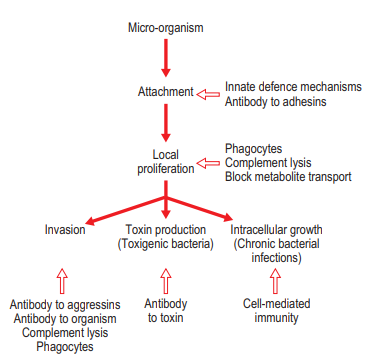
Specific antibodies can bind to flagella or fimbriae, affecting their ability to function properly, and can inactivate various bacterial enzymes and toxins. Antibodies therefore interfere with many important bacterial processes but, ultimately, phagocytes are needed to destroy and remove the bacteria (Fig. 12.1). In some situations cell-mediated responses are required.
Inflammation
Having successfully avoided the innate immune mechanisms that protect the individual (mechanical barriers, antibacterial substances and phagocytosis, described in Chapter 9), a bacterium starts to proliferate in the tissues. The presence of bacteria-specific molecules is recognized by pattern recognition receptors, leading to cytokine release. These cytokines, along with tissue-damaging toxic bacterial products, trigger an inflammatory reaction.
The resulting increase in vascular permeability leads to an exudation of serum proteins, including complement components, antibodies and clotting factors, as well as phagocytic cells. The phagocytes are attracted to the site of inflammation by chemotactic factors. Anaphylatoxins generated by complement activation further increase vascular permeability and encourage exudation of fluid and cells at the site of inflammation. Many of these mediators also cause vasodilatation, thereby increasing blood flow to the area.
Many types of micro-organism (e.g. staphylococci and streptococci) are dealt with effectively by the phagocytes. The intensity and duration of the inflammatory process that is stimulated depends on the degree of success with which the micro-organism initially establishes itself. This, in turn, depends on the extent of the injury, the amount of associated tissue damage and the number and type of micro-organisms introduced.
A localized abscess may arise at the site of infection. If bacteria are not eliminated at the site of entry and continue to proliferate, they pass via the tissue fluids and lymphatics to the draining lymph node, where a specific acquired immune response is generated. The antibody and effector cells generated will leave the node to return to the area of infection to eliminate the bacteria. Some capsulate micro-organisms, such as pneumococci, are able to resist phagocytosis and are not dealt with effectively until large amounts of antibody have been made.
These ‘mop up’ the released capsular polysaccharide, and phagocytosis occurs. Other micro-organisms produce exotoxins, and effective immunity to exotoxins requires the development of specific antibodies against the toxin (i.e. antitoxin). The types of infection described above are usually referred to as acute infections, and contrast with the protracted or chronic infections usually induced by bacteria that have adapted to survive within the cells of the host. Included among these are tuberculosis and leprosy, brucella infections and listeriosis. In these infections, cell-mediated immunity plays a predominant part in the final elimination of the micro-organism.
Humoral immunity
The attachment of a micro-organism to an epithelial surface is a prerequisite for the development of an infectious process (see p. 159). A first line of attack by antibody could be to inhibit colonization by stopping attachment. The immunoglobulin IgA can stop colonization of the mucosal surface if it interferes with the attachment molecules (adhesins) present on the bacterial surface. IgA does not activate complement very efficiently; therefore, an inflammatory reaction is not stimulated. Damage to the gut wall during an inflammatory reaction would allow the entry of many potential pathogens into vulnerable tissues. Many micro-organisms owe their pathogenic abilities to the production of exotoxins. Among diseases dependent on this type of mechanism are diphtheria, cholera, tetanus and botulism. Antibodies acquired by either immunization or previous infection, or given passively as antiserum, are able to neutralize bacterial toxins. Many bacterial exotoxins are enzymes, and protective antibody can prevent interaction of the enzyme with its substrate. The antibody can bind directly to the active site of the enzyme or to adjacent residues and inhibit by steric hindrance. Antibody may also act by stopping activation of a zymogen into an active enzyme, interfere with the interaction between the toxin and its target cell, or bind to a site on the molecule, causing a conformational change that destroys the enzymatic activity. The direct binding of antibody to a bacterium can interfere with normal bacterial functioning in numerous ways. Antibody can kill bacteria on its own or in conjunction with host factors and cells. To survive and multiply, bacteria must ingest nutrients and ions mainly by specific transport systems. Antibodies that affect the activity of specific transport systems will deprive the bacteria of their energy supply and other essential chemicals. Some bacteria are invasive, moving into the tissues aided by enzymes that they produce. Invasion can also be inhibited by antibody that attaches to the flagella of the micro-organism in such a way as to affect its motility. Antibodies can agglutinate bacteria, and formation of the aggregate will impede spread of the organism. In addition, the formation of an immune complex of bacteria and antibody will stimulate phagocytosis and complement activation. When a particle is coated with antibody, a large number of Fc portions are exposed to the outside. This increases the chance that the particle will be held in contact with the phagocyte long enough to stimulate phagocytosis. The interaction of multiple ligands increases the overall affinity of the binding and, if antibody and complement components are present on the same particle, the binding is even stronger. The bacteria are internalized and attacked by the oxygen-dependent and oxygen-independent killing mechanisms within the phagocyte. Phagocytes are also responsible for the removal and digestion of bacteria that have been killed extracellularly. Bacteria are susceptible to the lytic action of complement, which may be activated by bacterial components. The presence of antibody on the bacterial cell surface further stimulates the activation of complement. In certain circumstances, antibodies in conjunction with other bactericidal molecules lead to more efficient bacterial destruction. Gram-negative organisms are normally resistant to the action of lysozyme, probably because of the lipopolysaccharide component of the cell. The action of antibody and complement is thought to expose the underlying cell wall, which is then attacked by the lysozyme.
Cell-mediated immunity
Ultimately, all bacteria will be engulfed by a phagocyte, either to be killed or removed after extracellular killing. The host defence mechanisms of macrophages and monocytes can be enhanced by various activating stimuli, including microbial products such as the muramyl dipeptide found in many cell walls and trehalose dimycolate from Mycobacterium tuberculosis. The chemotactic formylmethionyl peptides have been shown to increase the activities of various macrophage functions. The linkage of chemotaxis to activation has the advantage that the cell being attracted to the site of tissue injury will be better equipped to deal with the insult. Endotoxins present in the cell wall of Gram-negative bacteria and various carbohydrate polymers, such as β-glucans, are potent macrophage activators. The immune system is also active in the production of macrophage-activating factors. In particular, lymphokines, produced by T lymphocytes, are often required to potentiate bacterial clearance both by attracting phagocytes to the site of infection and by activating them. The most important activator is γ-interferon, although tumour necrosis factor and colony-stimulating factors have also been implicated (see Ch. 9). All T lymphocytes produce some lymphokines when stimulated, and the balance of the different factors produced dictates the effect on surrounding cells. The overall effect of the lymphokines is to increase the effectiveness of host defence mechanisms, but if these molecules are produced in excess or to an inappropriate signal then a type IV hypersensitivity reaction can occur.
'Medical Microbiology' 카테고리의 다른 글
| 4. Bacterial growth, physiology and death(진행중) (0) | 2025.07.27 |
|---|---|
| 2. Morphology and nature of micro-organisms(진행중) (0) | 2025.07.26 |