Introduction
Enveloped viruses introduce their genomes into host cells by membrane fusion. With paramyxoviruses, such as Sendai virus, fusion is independent of pH and can occur at the cell surface (see Poste & Pasternak, 1978). However, in other groups of enveloped viruses, including toga-, orthomyxoand rhabdoviruses, the fusion activity is triggered only in mildly acidic (pH 5-6) conditions (see White et al., 1983).
For these viruses fusion occurs, after endocytosis of the intact viruses, with the membranes of acidic endocytic vacuoles (for reviews see Dales, 1973; Lonberg-Holm & Philipson, 1974; Helenius et al., 1980b; Howe et al., 1980; Dimmock, 1982; Lenard & Miller, 1982; Simons et al., 1982; Marsh et al., 1982a). Here recent work concerning the endocytosis of enveloped viruses and the role of the endocytic pathway in enveloped virus infection will be reviewed. The mechanism of viral membrane fusion will be discussed only briefly; for a full review see White et al. (1983).
Enveloped virus entry has been studied using several well-characterized viruses: SFV and Sindbis virus (togaviruses), FPV and influenza virus (orthomyxoviruses) and VSV (a rhabdovirus). The structures of these viruses have been described in detail (see Wagner, 1975; Garoff et al., 1982; Compans & Choppin, 1975).
Briefly, the alphaand orthomyxoviruses are spherical particles approximately 75 and lOOnm in diameter respectively, and VSV is a 150nm long bullet-shaped particle. All of these viruses contain a nucleocapsid surrounded by a membrane.
The nucleocapsid contains the viral nucleic acid complexed with one or more accessory proteins. The viral membrane, which originates from a membrane of the host cell, is a lipid bilayer, containing multiple copies of the viral membrane glycoproteins. The glycoproteins, which span the bilayer and project from the virion surface as spikes, are essential for viral infectivity and during entry have two principal tasks, (1) binding virions to the host cell surface, and (2) Abbreviations used: SFV, Semliki forest virus; FPV, fowl plague virus; VSV, vesicular stomatatis virus; BHK, baby hamster kidney; MDCK, Madin-Darby canine kidney. membrane fusion.
Viral spike glycoproteins are among the best-characterized membrane proteins. The complete amino acid sequences for several have been deduced (see White et al., 1983) and the three-dimensional structures of both of the influenza virus spike glycoproteins, the haemagglutinin and the neuraminidase, have been resolved (Wilson et al., 1981; Varghese et al., 1983).
Mechanisms of endocytosis
Most cells can internalize, or endocytose, extracellular ligands in plasma membrane-derived vesicles. Usually endocytosis occurs by two mechanisms.
The first, phagocytosis, is an inducible process which mediates the uptake of large particles (>200nm diameter) and is often a property of specialized cells such as macrophages. The second process, pinocytosis, is a constitutive property of virtually all cell types through which the medium, including solutes, macromolecules and small particulate ligands (<150nm diameter), is internalized (see Silverstein et al., 1977; Steinman et al., 1983; Besterman & Low, 1983). Pinocytosis includes both fluid phase and recep-tor-mediated (or adsorptive) endocytosis. Cells continually internalize the medium that surrounds them (fluid phase endocytosis). In fibroblasts an equivalent of 5-10% of the cell volume is taken up each hour (Steinman et al., 1976).
In addition, Steinman et al. (1976) estimated that pinocytic activity in L-cell fibroblasts and macrophages results in the internalization, and recycling to the cell surface, of the equivalent of 54% and 180% res-pectively of the cell surface areas/h. Despite the magnitude of fluid phase pinocytosis the uptake of ligands present in low concentrations is inefficient. The efficiency is increased when receptors that en-able a cell to select and concentrate specific ligands are used; this process is termed receptor-mediated or adsorptive endocytosis (see Goldstein et al., 1979; Steinman et al., 1983).
Many physiologically important macromole-cules enter cells by receptor-mediated endocytosis. Examples include nutrients (low density lipopго-tein, transferrin), polypeptide hormones and growth factors (insulin, epidermal growth factor) lysosomal hydrolases, asialoglycoproteins and serum proteinase inhibitors (a2-macroglobulin). Ligands are taken up through coated pits, in coated vesicles. The coated vesicles deliver the internalized ligands to a system of membrane-bound organelles termed the vacuolar apparatus. This system comprises the prelysosomal vacuoles (endosomes), multivesicular bodies, autophagic vacuoles and secondary lysosomes (Fig. 1).
In addition, the endoplasmic reticulum and Golgi apparatus are involved in the synthesis of lysosomal hydrolases and vacuolar membrane, and a population of vesicles, as yet uncharacterized, recycles membrane and some content to the cell surface (see Besterman et al., 1981; Steinman et al., 1976, 1983; Brown et al., 1983). In addition to physiological ligands, opportunistic ligands such as viruses and toxins also exploit the endocytic pathway to enter cells. For enveloped viruses, receptor-mediated endocytosis is best characterized for SFV uptake in BHK cells. The viruses bind to cell surface sites located preferentially on the microvilli. The bound viruses are translocated to coated pits at the base of the microvilli and are internalized in coated vesicles. The internalized viruses are collected in prelysosomal vesicles, endosomes, and eventually some viral components pass to, and are degraded in, the lysosomes (Fig. 1)
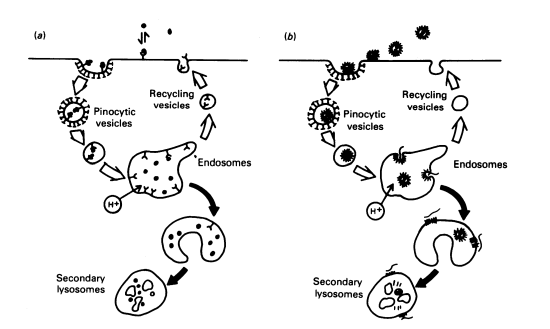
Fig. 1. The basic pathway ofpinocytosis and the entry pathway of Semliki Forest virus (a) A schematic representation of the pinocytic pathway showing an example of receptor-mediated endocytosis where the ligand binds to receptors on the cell surface, is internalized through coated pits and coated vesicles and enters the endosome compartment. The endosome is acidified by a proton ATPase and, in the acid environment, the receptor-ligand complex dissociates (see Helenius et al., 1983). The receptor is recycled to the cell surface for reutilization, while the ligand passes to the lysosome compartment. (b) A schematic representation of SFV entry into BHK cells. Acidification of the endosome in this case results in fusion of the viral membrane with the endosome membrane and the extrusion of the viral RNA into the cytoplasm. The viral spike glycoproteins, which are now components of the endosome membrane, and any unfused viruses, are subsequently degraded in the lysosomes.
Binding to the cell surface
To infect a cell a virus must first bind to the cell surface (see Lonberg-Holm & Philipson, 1974; Dimmock, 1982). Binding is best studied at low temperatures which inhibit pinocytosis (Steinman et al., 1974; Brown & Goldstein, 1979). At 0-4°C SFV, Sindbis virus, VSV and influenza viruses bind to various cell types, but are not internalized (Fries & Helenius, 1979; Helenius et al., 1980a; Marsh & Helenius, 1980; Matlin et al., 1981, 1982; Yoshimura et al., 1982; Miller & Lenard, 1980; Talbot & Vance, 1982; Schlegel et al., 1982). With SFV a binding constant of 3 x 101Om-1 has been measured on BHK cells (Fries & Helenius, 1979).
Binding is mediated by the viral spike glycoproteins (see Lonberg-Holm & Philipson, 1974; Dimmock, 1982). Subviral particles containing isolated SFV spike glycoproteins have been used to study binding. SFV spike glycoprotein rosettes and reconstituted lipid vesicles (virosomes) have binding properties on BHK cells similar to those of the intact virus. The particles bind preferentially to the microvilli, the binding is pH-dependent and the particles compete for binding sites with intact viruses (Fries & Helenius, 1979; Marsh et al., 1983a).
The efficiency with which the particles bind to cells is, however, reduced when compared with intact SFV. The reduced binding correlates with the lower valency of the respective particles, that is, the potential of each particle to make multiple contacts with the cell surface (Marsh et al., 1983a). Thus, the high avidity of SFV for BHK cells probably results from multiple low-affinity spike glycoprotein-receptor interactions. The low affinity of the individual spike glycoprotein-receptor complexes may enable a virus to use different cell-surface components as receptors, and may explain why specific receptors for enveloped viruses have proven difficult to identify.
The cell-surface binding sites for enveloped viruses are poorly characterized (see LonbergHolm & Philipson, 1974; Dimmock, 1982). The myxoviruses bind to sialic acid residues and, therefore, have a broad range of potential glycoprotein and glycolipid receptors. Less is known of the binding sites for other enveloped viruses. Several togaand retroviruses bind to proteinase-sensitive cellsurface components (Helenius et al., 1980a; Huggins et al., 1983; Andersen & Nex0, 1983), and with Sindbis virus and Friend murine leukaemia virus proteins of molecular mass 90 kDa and 14kDa respectively have been implicated as receptors on human lymphoblastoid cells and murine leukocytes (Maassen & Terhorst, 1981; Robinson et al., 1980). SFV shows specificity for the major histocompatibility antigens on murine and human lymphoblastoid cells (Helenius et al., 1978), but will also infect cells that do not express these antigens, again suggesting that different cell-surface components can be used as binding sites (Oldstone et al., 1980). SFV, Sindbis and influenza viruses will bind lipid (Mooney et al., 1975; White et al., 1980, 1982a), but only under conditions (low pH) which promote membrane fusion (White & Helenius, 1980; Vaananen & Kiaariainen, 1979, 1980; Lenard & Miller, 1981).
The situation with VSV is less clear. Binding to BHK cells, MDCK cells and mouse fibroblasts is inefficient, releaseable by both trypsin and EDTA, and shows marked pHdependence in a range above that required for fusion (Miller & Lenard, 1980; Matlin et al., 1982; Schlegel et al., 1982). Recently, Schlegel et al. (1983) suggested that phosphatidylserine is the receptor for VSV. Whether viruses that enter cells by the endocytic pathway need to bind to cell-surface components that normally mediate the endocytosis of physiological ligands is unclear. However, most cellsurface glycoproteins appear to get internalized (see Steinman et al., 1983). Multivalent ligands, such as viruses, will induce the formation of receptor clusters (see Helenius et al., 1980a). It is possible that clustering alone is sufficient for ligands to be trapped in coated pits (see below) and internalized in coated vesicles.
Viruses can also bind to cells through antibodies directed against viral surface antigens. Anti-viral antibodies enhance the infection of cultured mouse macrophages and BHK cells by alpha-, flavi- and bunyaviruses (Peiris & Porterfield, 1979, 1982; Kimura et al., 1981; Millican & Porterfield, 1982). Enhancement does not occur if Fab fragments of these antibodies are used, or if cells are incubated with anti-(Fc receptor) antibodies (Peiris et al., 1981), implying that antibodies bind the viruses to cell surface Fc receptors. The Fc receptors on macrophages are well known to effect receptor-mediated endocytosis (see Steinman et al., 1983; Mellman et al., 1983, 1984). Antibodyenhanced infection may account for increased replication of influenza and dengue viruses in individuals with antiviral antibodies, and for the dengue virus shock syndrome. The antibodies can occur in such individuals by exposure to antigenically related viruses or by injection of specific antibodies (Webster & Askonas, 1980; Halstead, 1980a,b).
Internalization
Fazekas de St.Groth (1948) proposed that influenza virus infection involves internalization of the virions (viropexis). Numerous morphological studies demonstrating virus particles in endocytic vacuoles have supported this proposal (see Dales, 1973). However, it has remained unclear how the viruses are internalized and whether or not internalization results in infection. Recent biochemical and morphological studies show that a number of enveloped viruses enter cells through receptor-mediated endocytosis.
As described with a number of physiological ligands (see Goldstein et al., 1979; Steinman et al., 1983) the internalization occurs through specialized regions of the plasma-membrane, the coated pits (Roth & Porter, 1964; Fawcett, 1965; Goldstein et al., 1979). The coated pits appear to invaginate into the cell, encapsulating any ligand associated with them, to form coated vesicles. An alternative mechanism for the receptormediated internalization of bound ligands has been proposed (Willingham & Pastan, 1980; Wehland et al., 1981; Dickson et al., 1981). By this mechanism, internalization occurs through large smooth surface vesicles (receptosomes) that bleb from the side of coated pits. The images of coated vesicles are suggested to result from sections cut through coated pits which do not contain the connection to the cell surface. Such images undoubtedly exist (see Bretscher et al., 1980; Wall et al., 1980), however, a serial section analysis (Peterson & van Deurs, 1983) clearly shows that coated vesicles are discrete structures, without morphological connections to the cell surface, that are involved in the internalization of adsorbed ligands.
Togaviruses (Pathak et al., 1976; Helenius et al., 1980a), rhabdoviruses (Simpson et al., 1969; Dahlberg, 1974; Matlin et al., 1982), paramyxoviruses (Morgan & Howe, 1968), orthomyxoviruses (Patterson et al., 1979; Matlin et al., 1981) and retroviruses (Dales & Hanafusa, 1972) have been observed in coated vesicles.
Kinetic studies with SFV, FPV and VSV indicate that this association with coated vesicles is coupled with the initial internalization event (Helenius et al., 1980a; Matlin et al., 1981, 1982). SFV has been used to estimate the magnitude of coated vesicle uptake in BHK cells. At high multiplicities (90000 viruses/cell) about 3000 virus particles/min enter a cell. Electron micrographs of these cells show an average of 1.3 viruses/viruscontaining coated vesicle. This means that about 2400 coated vesicles/min leave the cell surface at 37°C (Marsh & Helenius, 1980).
Furthermore, SFV does not induce the formation of coated vesicles but uses vesicles which are continually moving into the cell from the cell surface. This was demonstrated by the following experiment: one SFV particle is calculated to occupy 0.25 the internal volume of a coated vesicle; if viruses induce the formation of coated vesicles then, at high multiplicities, an increase in fluid-phase endocytosis equivalent to 0.75 the volume of the viruscontaining coated vesicles would be expected. In actuality, a temporary decrease in fluid phase uptake is measured. The decrease is approximately equal to the volume of fluid displaced from coated vesicles by the viruses (Marsh & Helenius, 1980; Marsh et al., 1982a). The experiments with SFV show that endocytosis by coated vesicles has a high capacity and is a constitutive property of cells. We have calculated that 2400 coated vesicles/min leaving the cell surface can account for both the measured fluidphase endocytosis in BHK cells and for the membrane uptake (assuming values equivalent to those measured by Steinman et al., 1976).
This further suggests that in BHK cells fluid-phase endocytosis, receptor-mediated endocytosis and membrane uptake are integrated properties of the same endocytic pathway. The number of coated vesicles leaving the cell surface is large enough to ensure that bound ligands are taken up with high efficiency. For physiological ligands such as low-density lipoprotein, asialoglycoproteins or a2-macroglobulin, half times on the surfaces of various cell types of 2-5 min have been measured (see Steinman et al., 1983). With SFV the half-time at the BHK cell surface is 7- 10min (at 37°C) and virtually all bound viruses are cleared, regardless of the multiplicity (Marsh & Helenius, 1980).
FPV and influenza virus also have similar half-times on the surface of MDCK cells (Matlin et al., 1981; Yoshimura et al., 1982). However, with VSV on these same MDCK cells the half-time is about 30min (Matlin et al., 1982) and on both BHK and MDCK cells only half of the bound virus is cleared (Miller & Lenard, 1980; Matlin et al., 1982). The variation in the efficiency of clearance may be explained by the viruses using receptors which internalize at different rates or, alternatively, by the different sizes of the viruses. Orthomyxoviruses and SFV are relatively uniform particles which are easily contained within endocytic coated vesicles (average diameter 80- 100 nm). The bullet shaped VSV particle, on the other hand, is larger than the average coated vesicle and its inclusion in most, though clearly not all, coated vesicles may be limited. After leaving the cell surface, coated vesicles rapidly ( < 2 min) lose their coats (Anderson et al., 1977).
"바이러스의 세포 내부화 효율은 그 바이러스가 사용하는 '수용체의 특성'과 바이러스 자신의 '크기 및 형태'라는 두 가지 주요 요소에 의해 결정된다."
When cells, with bound SFV, are warmed to 37°C the virus particles are seen in coated vesicles within 15s and, by 1min, in large 200-SOOnm electron-lucent vacuoles termed endosomes (Helenius et al., 1980a). The endosomes are components of a prelysosomal compartment which, cytochemically, is devoid of lysosmal markers (acid phosphatase and aryl sulphatase: Tycko & Maxfield, 1982; Wall et al., 1980), and which can be fractionated away from most lysosomal activities by density gradient centrifugation (Tolleshaug et al., 1979; van Renswoude et al., 1981; Marsh et al., 1983b; Merion & Sly, 1983; Galloway et al., 1983). After a delay of 20min virus components reach the lysosomes. Entry into the lysosome compartment is indicated both morphologically (see Dales, 1973; Helenius et al., 1980a; Matlin et al., 1981, 1982) and by the appearance of the products of virus degradation in the medium (Marsh & Helenius, 1980; Matlin et al., 1981, 1982; Yoshimura et al., 1982). The lag in the appearance of degradation products results from the time taken for the viral components to reach the lysosomes and not from delayed activity of the lysosomal hydrolases (Marsh et al., 1983b). Fractionation of cells labelled with Sindbis virus and VSV indicates a similar association with endosomes and lysosomes as described for SFV (Talbot & Vance, 1982; Brooks et al., 1982).
Intracellular penetration
The fact that a number of enveloped viruses require low pH to trigger the membrane fusion activity, the observation that virus particles are endocytosed and pass to lysosomes, and the known low pH of lysosomes suggested that virus penetration occurs intracellularly in lysosomes (see Helenius et al., 1980a; Miller & Lenard, 1980; Marsh et al., 1982a). Further, for SFV, VSV, influenza and Sindbis virus fusion is not seen at the cell surface (Dahlberg, 1974; Dourmashkin & Tyrell, 1974; Helenius et al., 1980a; Matlin et al., 1981, 1982), the antigens from infecting viruses are not detected on the cell surface after entry (Fan & Sefton, 1978) and the internalized viruses are infective (Helenius et al., 1982). Although lysosomes have been implicated in penetration, further examination of the kinetics of entry indicate that SFV penetration occurs early after endocytosis, from the endosomes. Within 5- 7 min of the virus leaving the cell surface, uncoated RNA can be detected in the cytoplasm. Whereas degradation, indicating entry into lysosomes, is not detected until 20min after internalization.
In addition, weak bases, which raise the pH of intracellular acidic vesicles (see below), do not inhibit infection if added to cells more than 10min after the viruses (Helenius et al., 1980a; Helenius & Marsh, 1982). To confirm that SFV penetration occurs from endosomes we exploited an observation that asialoglycoprotein taken into hepatocytes at 20°C remains in endosomes and fails to reach the lysosomes (Dunn et al., 1980). We found in BHK cells that SFV is also retained in endosomes at 20°C; the virions do not pass to lysosomes and degradation is not observed (Marsh et al., 1983b). Under these conditions virions are, however, uncoated and initiate infection, demonstrating that the fusion reaction occurs in the endosomes. Furthermore, a mutant of SFV which fuses at pH <5.5 (as compared with pH 6.0 for the wild type) will also uncoat and infect cells at 20°C (Kielian et al., 1984). Recently, intracellular fusion of SFV with the membrane of endosomes has been observed morphologically (A. Helenius & E. Bolzau, unpublished work).
These results demonstrate several important properties of endosomes and the endocytic pathway. Firstly, the endocytic pathway is acidified prior to the lysosomal compartment and, as the fusion mutant infects cells at 20°C, the endosomes are acidic to at least pH5.5. Secondly, the endocytic pathway is acidified rapidly; internalized ligands encounter pH6.0 (the pH required for wild type SFV fusion) within 5min of internalization. Tycko & Maxfield (1982) and van Renswoude et al. (1982), using fluorescein-conjugated Ox2-macroglobulin and transferrin as pH probes, have estimated the endosome pH in murine fibroblasts and human erythroleukemia cells to be 5.0 + 0.2 and 5.5 + 0.4 respectively. Finally the results with SFV show that endosome membranes contain cholesterol, which is required in the target membrane for SFV fusion (White & Hellenius, 1980). The penetration of SFV from endosomes enables this virus to accomplish the crucial fusion step before entering the hydrolytic lysosomal compartment. Thus the functions of the viral spike glycoproteins are completed prior to their degradation. The intracellular fusion site for other enveloped viruses has not been defined. However, VSV fuses at pH 6.0 (White et al., 1981) and may also be expected to penetrate from endosomes. Similarly, the fact that an SFV fusion mutant penetrates from endosomes indicates that endosomal pH may be low enough to trigger fusion in strains of influenza virus which fuse at pH 5.3 (White et al., 1982a).
Acidification
The acidification of the endocytic pathway is necessary not only to activate lysosomal hydrolytic enzymes but may also be involved in the dissociation of some ligand-receptor complexes, in sorting events of the endocytic pathway, and in the control of membrane recycling (Brown et al., 1983; Helenius et al., 1983). Acidification of lysosomes involves an ATP-driven proton pump (see Reeves, 1983). Studies have now demonstrated a similar pump in the membranes of endosomes (Galloway et al., 1983; Maxfield, 1982). This pump has been characterized in endosomes isolated from a mouse macrophage-like cell line (J774) and from BHK cells. Fluorescein-conjugated dextran was used as a pH probe. The emission intensity of fluorescein is a titratable function of pH in the pH range 4-8. Changes in the emission intensity can be used as very sensitive indicators of pH changes (see Ohkuma & Poole, 1978). Endosomes labelled with fluorescein-conjugated dextran acidify rapidly on addition of ATP (Galloway et al., 1983) or GTP (C. Galloway & I. Mellman, unpublished work). The acidification is not affected by inhibitors of the mitochondrial F1-Fo ATPase or (Na+ +K+)- ATPase and does not require permeant anions. At present, N-ethylmaleimide is the only reagent demonstrated to inhibit the pump. How does the endosome acquire the proton ATPase? A proton ATPase, with properties very similar to those of the endosome ATPase, has been demonstrated in isolated coated vesicles (Forgac et al., 1983; Stone et al., 1983). It is therefore possible that the pump enters the endocytic pathway from the cell surface and that incoming coated vesicles contain the components necessary to form an endosome. The interest in acidification as a control mechanism in the endocytic pathway has prompted attempts to find mutant cells with deficiencies in functions of the endocytic pathway which depend on acidification. The selection of such mutants has been facilitated using toxins, such as diphtheria toxin, which also require low pH to enter the cell (Draper & Simon, 1980; Sandvig & Olsnes, 1980). Several groups of these toxin-resistant mutants show marked resistance to enveloped viruses including SFV, VSV and Sindbis virus (Moehring & Moehring, 1972; Robbins et al., 1983). The lesion does not affect binding or endocytosis but appears to be at the level of intracellular penetration and can be overcome by introducing either the toxin or the viruses through the plasma membrane by brief low pH treatment. The implication is that these mutants do indeed have a defect in acidification; however, it remains unclear whether the proton ATPase is defective or whether an alternative defect exists, such as altered permeability properties of the endosome membrane.