Box 1 | Phage life cycles and taxonomy There is considerable diversity among phages, and both genomic and morphological information is currently used in their classification67,90. As we learn more about the diversity of phages and their genomic mosaicism, their taxonomy and classification require regular updating and have been said to be “as much an art as a science” (REF. 67). Initially, d’Hérelle believed that there was only one phage with many ‘races’. Subsequently, electron microscopy from the 1940s4 enabled phage taxonomy based on morphology. In 1962, the Lwoff, Horne and Tournier (LHT) virus classification system was developed, which included the type of nucleic acid (DNA or RNA), capsid morphology and enveloped nature91. In 1966, what is now the International Committee on Taxonomy of Viruses (ICTV) was established to provide a universal viral taxonomy, and in 2011 it released its ninth report90. The genetic material of phages consists of double-stranded (ds) or single-stranded (ss) DNA or RNA, and their genome sizes can range from very simple (for example, ~3.5kb ssRNA genome in phage MS2) to highly complex (for example,~500kb dsDNA genome in Bacillus phage G) and can include modified nucleotides as protection against restriction enzymes. Morphologically, phages can be tailed, polyhedral, filamentous or pleomorphic, and some have lipid or lipoprotein envelopes67,90. Recently, the prokaryote virus subcommittee of the ICTV has considerably systematized phage and archaeal virus taxonomy90.Details of the classification system can be accessed on the ICTV website. Most characterized phages belong to the Caudovirales order (dsDNA genome with a tailed morphology), which is divided into the following families: Myoviridae (for example, phage T4), Siphoviridae (for example, phage λ) and Podoviridae (for example, phage T7)67.
Phages can have lytic or lysogenic life cycles (see the figure)80.To infect a host bacterium, a phage will first interact with receptors on the host cell, adsorb and then inject its genome. The subsequent replication strategy will depend on whether the phage is virulent or temperate. Virulent phages, such as phage T4, are only able to replicate through the lytic cycle, a process involving the production of new viral progeny and their release from the infected cell. Alternatively, temperate phages (for example, phage λ) enter either the lytic cycle or form a stable association with the host, termed lysogeny. During lysogeny, the viral genome is termed a prophage and replicates in concert with the host DNA, either in a free, plasmid-like state (for example, phage P1) or integrated into the bacterial chromosome (for example, phage λ). Under conditions of stress, prophages can exit the lysogenic state and produce more virions that are released from the bacterium. Typically, release of phage progeny results in bacterial death through cell lysis52,54, although filamentous phages are released by ‘secretion’ through the outer membrane, thereby avoiding bacterial lysis but causing a chronic infection that slows growth of the host cell63.
Box 2 | CRISPR–Cas adaptive immune systems CRISPR–Cas systems provide adaptive immunity to bacteria and archaea against foreign invaders, such as plasmids and phages83. However, they can also be involved in diverse cellular processes92. The CRISPR arrays provide the ‘immune memory’ and consist of short repeats separated by ‘spacer’ sequences derived from the invading mobile genetic elements (MGEs). The Cas proteins impart the machinery for defence against the incoming nucleic acids93. CRISPR–Cas systems are divided into two major classes, five major types (type I–V) and multiple subtypes94. Three types (type I–III) and recently type V95 have been characterized mechanistically, and they show significant differences, despite conserved overall functional principles. CRISPR–Cas systems work in three steps, termed adaptation (or acquisition), expression and interference (see the figure). Adaptation involves the endonucleases Cas1 and Cas2, which acquire the new spacer and add this to the CRISPR, with concomitant repeat duplication. During expression, the cas genes and CRISPRs are transcribed. The full length CRISPR transcript is termed the pre-CRISPR RNA (pre-crRNA) and is processed into CRISPR RNAs (crRNAs) containing the MGE-derived spacer sequence and portions of the repeats. Generation of crRNAs differs between systems. In class 1 (type I and type III) systems, crRNA production typically involves a Cas6 endoribonuclease. In class 2 (type II and type V) systems: type II systems require Cas9, host RNase III and a non-coding RNA (transactivating crRNA (tracrRNA)) for pre-crRNA processing, whereas in the type V systems Cpf1 generates crRNA independently of a tracrRNA. In class 1 systems, the crRNA forms part of a Cas–ribonucleoprotein complex, whereas in class 2 systems a single protein (Cas9 or Cpf1) forms a complex with crRNA and, for Cas9, also with tracrRNA. During interference, these complexes recognize and degrade the MGE. In type I systems, recognition of complementary DNA (the protospacer) results in the recruitment of Cas3, which degrades the invader DNA. Type III systems target RNA and DNA in a transcriptiondependent manner. Finally, type II and type V interference results in DNA degradation by the Cas9–tracrRNA–crRNA or Cpf1–crRNA complexes, respectively (for recent reviews please refer to REFS 83,92,93). In addition to the applications of CRISPR–Cas, the biology of these systems is equally impressive and is revealing new dimensions of phage– bacterium interactions. For example, when becoming ‘immunized’ by a MGE, some CRISPR–Cas systems preferentially acquire new spacers from the invader in a replication-dependent manner96. This limits problems of ‘autoimmunity’, and suggests an enhanced response against aggressively replicating MGEs. Type III systems have another trick to target lytic phage reproduction, without self-targeting prophages in the bacterial genome97. By targeting both RNA and DNA in a transcription-dependent manner, these systems only interfere with transcriptionally active phages. However, phages can evade CRISPR–Cas through point mutations that disrupt the complementarity during targeting81,98. Surprisingly, in a process termed ‘priming’, CRISPR–Cas systems can detect even heavily mutated invaders and rapidly acquire spacers to generate renewed immunity98. Not to be outdone, some phages overcome CRISPR–Cas immunity by expressing anti-CRISPR proteins that inhibit the resistance machinery99. In a further twist, a Vibrio cholerae phage encodes a CRISPR–Cas system required for replication in strains containing an anti-phage-inducible chromosomal island (PICI)100. Evidently, there is still much to learn about CRISPR–Cas systems and their evolutionary relationship with phages and other MGEs. PAM, protospacer adjacent motif.
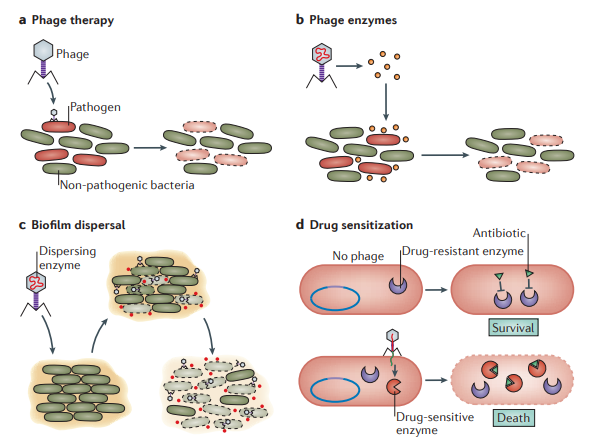
Figure 3 | Some phage-inspired antimicrobial approaches. Phages and their products provide routes that could lead to the creation of novel antimicrobial strategies. a | The specificity of phages can be explored for phage therapy, by which phages target particular bacterial pathogens. b | Phage products, such as enzymes, can be used to target specific bacteria, including pathogens. c | Phages can be used to disrupt biofilms, by targeting bacteria embedded in these structures, and can be engineered to release specific enzymes that degrade the biofilm matrix. d | Phages can be used to sensitize antibiotic-resistant bacteria. For example, phages can introduce antibiotic-sensitive genes into drug-resistant hosts, and this strategy can be combined with antibiotic treatment.